the out of tune guitar
hums angrily
forced to sing
by an unloved hand
assisting to proclaim
the glories of the earth abroad
the honors of a name
that hurts my lips
to say right now
sitting next to those
sitting next to me
with their heavy
and their out of tune
and their loud
and their noise
and some say that.s the sound
of the saints and you.re
avant-garde
Sunday, February 6, 2011

Thursday, February 3, 2011
My First Rebellion
i've started writing poetry again
because what else is there to do
when you hang out by yourself at night
which is a really stupid question
because there.s plenty of other
things to do
(let.s remain close to the ground my poet friend said
which is not really a possibility
when you.re writing poetry
but i say sure let.s )
it.s taken me a year and a half to get
used to humble origins and my core
which has never changed despite
the many layers i.ve gained through
friendship and environment changes
when you dig deep into the layered self
the blood runs thick
when you reach the other side
theoretically because it.s not really a possibility
without serious damage to the self
you find that there.s no center and
are able to say with confidence everything is a layer
without sounding heavy handed
except when you say it to other people or in a poem
layers are a good thing
some people pay for them
and many of us put them on when it.s cold
good art has many layers
and this is not good art
this is a lazy diary entry
this is a letter to a friend
poetry was my first rebellion
from grammar and rules
against institution and structure
love of the common people
was half of a band name
whole of people i love
and the words of a tattoo i will get one day
my last rebellion
will hopefully not be a poem
because what else is there to do
when you hang out by yourself at night
which is a really stupid question
because there.s plenty of other
things to do
(let.s remain close to the ground my poet friend said
which is not really a possibility
when you.re writing poetry
but i say sure let.s )
it.s taken me a year and a half to get
used to humble origins and my core
which has never changed despite
the many layers i.ve gained through
friendship and environment changes
when you dig deep into the layered self
the blood runs thick
when you reach the other side
theoretically because it.s not really a possibility
without serious damage to the self
you find that there.s no center and
are able to say with confidence everything is a layer
without sounding heavy handed
except when you say it to other people or in a poem
layers are a good thing
some people pay for them
and many of us put them on when it.s cold
good art has many layers
and this is not good art
this is a lazy diary entry
this is a letter to a friend
poetry was my first rebellion
from grammar and rules
against institution and structure
love of the common people
was half of a band name
whole of people i love
and the words of a tattoo i will get one day
my last rebellion
will hopefully not be a poem
Saturday, August 21, 2010
My First Story

A man woke up and realized something was wrong.
He talked it over with his best friend, and they came to the conclusion that the world and people were imperfect.
Upon finishing the conversation, the man said to his friend, "You know, Fred, if we solved this, we could make a lot of money"
Friday, August 20, 2010
Hymns
"I'm not actually a Christian with a capital C. I'm still asking questions. But I had this time when I found myself singing all these old hymns in my kitchen and I couldn't work out why I was doing it. Then one Sunday morning I got up, looked at my watch, and thought, 'I wonder if I could make it to a church service?' It was so welcoming. It just felt like you were coming home. Twelve years later, I've never left."
-Stuart Murdoch
-Stuart Murdoch
Monday, August 16, 2010
Can't get enough.
This song is so damn good...
Inspired me to go look for news on the infamous rapper and, to my sweet surprise, discovered a live performance of one of his new song that samples Billy Joel's Movin' Out!
Inspired me to go look for news on the infamous rapper and, to my sweet surprise, discovered a live performance of one of his new song that samples Billy Joel's Movin' Out!
Tuesday, August 10, 2010
Bolano, you have revived literature for me, however briefly.
"For a while, Criticism travels side by side with the Work, then Criticism vanishes and it's the Readers who keep pace. The journey may be long or short. Then the Readers die one by one and the Work continues on alone, although a new Criticism and new Readers gradually fall into step with it along its path. Then Criticism dies again and the Readers die again and the Work passes over a trail of bones on its journey toward solitude. To come near the work, to sail in her wake, is a sign of certain death, but new Criticism and new Readers approach her tirelessly and relentlessly and are devoured by time and speed. Finally the Work journeys irremediably alone in the Great Vastness. And one day the Work dies, as all things must die and come to an end: the Sun and the Earth and the Solar System and the Galaxy and the farthest reaches of man's memory. Everything that begins as comedy end as tragedy."
Gold from Robert Bolano's Savage Detectives.
Gold from Robert Bolano's Savage Detectives.
Friday, July 30, 2010
'Hm, good point,' I thought from my comfortable coach in my safe, suburban home...
"There are people who trust in the infectious power of nonviolence: sooner or later it will be crowned with success. In this belief, however, one can smell a bit too much of the sweet aroma of a suburban ideology, entertained often by people who are neither courageous nor honest enough to reflect on the implications of terror taking place right in the middle of their living rooms. The rood of nonviolence in the world of violence often leads to suffering: one can sometimes break the cycle of violence only at the price of one's life, as the example of Jesus demonstrates. If history is any guide, the prospects are good that nonviolence will fail to dislodge violence."
From Miroslav Volf's Exclusion & Embrace
Sunday, July 25, 2010
Hope for Today -- The 1990s
The vision: A roller skating ring complete with fluorescent DJ lighting, smoke machines and the clatter, insecure, we circled endlessly; the heat and the noise, every moment the end and the beginning, an endless inner ache for god-knows-what, the invisible current, the revelation of rhythm and love, my mouth open wide to exhale and swallow.
Yes, you, Jocelyn Enriquez, gave us hope.
Do You Miss Me (Music Video)
Yes, you, Jocelyn Enriquez, gave us hope.
Do You Miss Me (Music Video)
Monday, July 19, 2010
The Real McCoy
My dream is to meet all my friends on a group video chat and dance to this song on repeat till we all pass out. As someone on youtube once said, "I met my wife @ a club dancing to this song." Amen, brother. The magic, the noise.
Saturday, May 1, 2010
Exegesis of John Darnielle's Best Ever Death Metal Band out of Denton
The best ever death metal band out of denton
were a couple of guys, who'd been friends since grade school.
One was named cyrus, and the other was Jeff,
and they practiced twice a week in Jeff's bedroom.
The best ever death metal band out of denton
never settled on a name, but the top three contenders,
after weeks of debate,were Satan's Fingers,
and The Killers, and the Hospital Bombers.
Jeff and Cyrus believed in their hearts they were headed
for stage lights and leer jets, and fortune and fame.
So in script that made prominent use of a pentagram,
they stenciled their drumheads and guitars with their names.
This was how Cyrus got sent to the school
where they told him he'd never be famous,
and this was why Jeff,
in the letters he'd write to his friend,
helped develop a plan to get even.
when you punish a person for dreaming his dream,
don't expect him to thank or forgive you.
the best ever death metal band out of denton
will in time both outpace and outlive you.
Hail satan, hail satan tonight. Hail satan, hail hail.
I'm touched every time I hear this song. In this simple tune, Darnielle manages to capture and preserve the elusive, hidden evil behind many modern tragedies, not a paranormal sightings of the mytho-symbolic Satan of the Christian tradition, but a Weight, the awful heaviness that arises after encounters with senseless and needless physical and psychological violence.
In this case, the absurd situation arises from tragic misunderstanding. Children, naively hailing the person/symbol of the 'Evil One,' act out maliciously in the name of the most infamous anti-hero of the West, attempting actualize and express their innermost vision and desire. They collide with adults, who, instead of engaging with the children on the human plane, where healthy unpacking and analysis of emotional ad psychological needs can happen, engage on the symbolic and esoteric plane. As a result the children are seen as possessed, abnormal, disturbed, and, perhaps, inhuman.
Presumably, the "plan to get even" refers to a plan to kill those who, by punishing them for their choice of symbols, traumatized the teens' internal constellation of emotions, desires and hopes. The exact fears of the community, projected onto the teens, is realized in the teen's reaction. As has been seen in the US, the results of such types of cases are, mildly put, tragic. The hidden groan of man in his powerlessness appears veiled—"Hail Satan".
Saturday, December 19, 2009
Christmas reflection on the Virgin Mary
 My appreciation for Mary is slowly growing. Its difficult to overcome my inherent protestant fears of this mysterious figure of the Gospel, but the symbolic and spiritual weight of her character in the gospels I can no longer ignore. There are a number of views that seem to be particularly fruitful foci for understanding Mary in light of her uniqueness.
First, there is the view of Mary as mother of mankind, an angle which plays up her singularity as the mother of the Christ. It can not be denied that Mary is the vessel by which the first Man makes His way into the world; before this there existed only shadows of man, which were themselves shadows of Man. Strange and wonderful, then, is Mary, whose DNA was to provide source of the Messiah's genetic code (Though I'm not sure what I think of the historical credibility of the virgin birth, it is nonetheless interesting to speculate that Jesus' genetic code would be, if the virgin birth is factual, solely based on Mary's patterns. I wonder, then, how many times he heard, "you favor your mother" :)). What does it mean for Mary to be the mother of mankind? There are extreme positions: one makes this fact a justification for her apotheosis via religious ritual practices, the best example being the recitation of the Rosary, varying in spiritual significance from community to community, the other minimizes this fact to the point of nonexistence. What is a healthy understanding? Not sure, something to think about.

Second, there is the view of Mary as a unique physical symbol of the Christian's spiritual reality as well as a call to all mankind. This view of Mary I heard recently in a homily given during a catholic funeral for my great Aunt. It seemed new to me at the time, but upon reflection I realized I heard it before in the last verse of the traditional Christmas song, "O Little Town of Bethlehem," which begins,
"O little child of Bethlehem,
descend to us we pray,
cast out our sin and enter in,
be born in us today."
In these few lines we see articulated the perpetual rebirth of Jesus in the new Christian's heart. Mary was, in fact, the first Christian. She opened her womb to the Messiah, accepting, quite literally, the Christ. Interestingly, she does not accept this weight with a mere 'yes'. Rather, she says, "Behold, I am the servant of the Lord; let it be to me according to your word." Her acceptance is in the form of a declaration that she is and will be a servant of the Living God. One might argue that the acceptance of Christ is much more complicated than a simple agreement to live as the servant of God, but I'm not convinced that it is anything more than that. Of course, there is the forgiveness of sins going on somewhere in the background, but, in essence, Jesus' gospel is a call to enter into the Kingdom of God as a servant, to have the will of God played out in one's life and to bring about the will of God in the lives of others. Thus, Mary's acceptance of the Messiah is a physical symbol of the spiritual event that takes place in a new Christian. Christ is born in the heart of a man or woman and then matures and grows in him or her till He bursts forth from them as light, love, and truth. Christ's birth and growing in a Christian is not parasitical, being a kind of possession or take-over, but rather synergistic, uniting God and man mysteriously resulting in the new, complete Man. Christ's explosion out of a person is seen in the self-actualization of the person and his or her highest expression of innate self for the benefit of others and the glory of God. Mary is the physical symbol for this event, but, in being so, she is also more. In the same way the story of those who have experienced this ultimate spiritual event serves as testimony and a call to others, so does Mary stand as a physical testimony and a call to all men and woman—will you too 'prepare Him room' in your heart and accept the call to enter into the Kingdom of God as a servant?
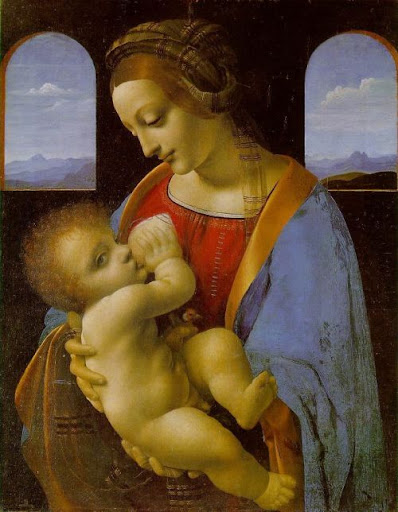
There are other views of Mary that are worth discussing, but that's all I have the energy to write about right now (Mary as a paranormal phenomena, Mary is a cultic object of worship, Mary as the goddess of Christianity, etc.). There are some great essays and works of art that make highly idiosyncratic symbolic uses of Mary that would be worth a look if you're interested and which have contributed to my growing interest in her as a figure. To name a few, the film director Godard, if I remember correctly, held her in high esteem, discussed her from time to time and made a movie about her; Octavio Paz has a great chapter in his book, El Laberinto de la Soledad [The Labyrinth of Solitude] , in which he discusses her role in Mexican Catholicism; Sion Sono's, a terrific Japanese director, recent film, Love Exposure, uses Mary as a central motif as well as various other Christian symbols throughout in fascinating ways; Chris Ofili's has a terrific Mary painting that caused a lot of controversy (seen above); Bresson's Journal d'un curé de campagne [Diary of a Country Priest] contains some great material as well.
P.S. In an increasingly visual age, my passions and loves feel more and more obsolete and shabby (the written word in its many forms and practices...). I want to write a eulogy in the form of a book to the recent passing of the Word to help me properly mourn.
Sunday, December 6, 2009
I'm going to regret posting this later
An Attempt to Tip the Scales
Bright Eyes
Did you expect it all to stop at the wave of your hand?
Like the sun's just gonna drop if it's night you demand.
Well, in the dark we're just air, so the house might dissolve.
But once we're gone, who's gonna care if we were ever here at all?
Well, summer's gonna come, it's gonna cloud our eyes again.
No need to focus when there's nothing that's worth seeing.
So we trade liquor for blood in an attempt to tip the scales.
I think you lost what you loved in that mess of details.
They seemed so important at the time
but now you can't even recall any of the names, faces, or lines.
It's more the feeling of it all.
Well, winter's gonna end, I'm gonna clean these veins again.
So close to dying that I finally can start living.
I listened to a lot of Bright Eyes my senior and junior year of high school. In college I more or less stopped because I got fed up with Connor Oberst's self-pity. Yesterday I found an old burned copy of Fevers and Mirrors in my bedroom cd caseand decided to give it a spin in the good ol' car stereo for old times sake. Expecting to be embarrassed that I had once listened to this album religiously, I played the first couple of tracks and to my surprise thoroughly enjoyed them.
I'm not sure whether to attribute this enjoyment to the simply explosion of pleasure that occurs when you re-encounter a old, loved object or person or to the intrinsic worth of the music itself. I'm leaning towards the former (Evidence: I recently listen to and enjoyed the early Offspring album, Smash). Oberst's music always gave me huge emotional highs in high school and much to my surprise it did once again today. I'm not sure why. It used to awaken my imagination and, almost magically, did so again today. In spite of his many flaws, Oberst can pen a decent song, whose primary strength are the communicate of an ineffable sense of, well, feeling. While that may seem stupid or trite, for INFPers like myself, its huge (Feeling is crack cocaine for an INFPer). Because O'berst songs avoid, for the most part, musical and lyrical predictability, they're good for multiple listens, faithfully giving heavy doses of emotional excess to hungry teenage souls.
The above song is from the second to last track on Fevers and Mirrors. I listened to it multiple times in the car today because I kept wanting to hear the lines "summer's gonna come..." and "winter's gonna end..." I want 'summer' to come cloud my eyes.
[if I were 18 again I could justify writing this post, being 23 makes this embarrassing)
If you decide to listen to this song, I would suggest not listening to the interview.
Bright Eyes
Did you expect it all to stop at the wave of your hand?
Like the sun's just gonna drop if it's night you demand.
Well, in the dark we're just air, so the house might dissolve.
But once we're gone, who's gonna care if we were ever here at all?
Well, summer's gonna come, it's gonna cloud our eyes again.
No need to focus when there's nothing that's worth seeing.
So we trade liquor for blood in an attempt to tip the scales.
I think you lost what you loved in that mess of details.
They seemed so important at the time
but now you can't even recall any of the names, faces, or lines.
It's more the feeling of it all.
Well, winter's gonna end, I'm gonna clean these veins again.
So close to dying that I finally can start living.
I listened to a lot of Bright Eyes my senior and junior year of high school. In college I more or less stopped because I got fed up with Connor Oberst's self-pity. Yesterday I found an old burned copy of Fevers and Mirrors in my bedroom cd caseand decided to give it a spin in the good ol' car stereo for old times sake. Expecting to be embarrassed that I had once listened to this album religiously, I played the first couple of tracks and to my surprise thoroughly enjoyed them.
I'm not sure whether to attribute this enjoyment to the simply explosion of pleasure that occurs when you re-encounter a old, loved object or person or to the intrinsic worth of the music itself. I'm leaning towards the former (Evidence: I recently listen to and enjoyed the early Offspring album, Smash). Oberst's music always gave me huge emotional highs in high school and much to my surprise it did once again today. I'm not sure why. It used to awaken my imagination and, almost magically, did so again today. In spite of his many flaws, Oberst can pen a decent song, whose primary strength are the communicate of an ineffable sense of, well, feeling. While that may seem stupid or trite, for INFPers like myself, its huge (Feeling is crack cocaine for an INFPer). Because O'berst songs avoid, for the most part, musical and lyrical predictability, they're good for multiple listens, faithfully giving heavy doses of emotional excess to hungry teenage souls.
The above song is from the second to last track on Fevers and Mirrors. I listened to it multiple times in the car today because I kept wanting to hear the lines "summer's gonna come..." and "winter's gonna end..." I want 'summer' to come cloud my eyes.
[if I were 18 again I could justify writing this post, being 23 makes this embarrassing)
If you decide to listen to this song, I would suggest not listening to the interview.
Monday, November 30, 2009
Sufjan Steven's "It's christmas! Let's be glad"
FUN! :). Terrible quality, but such a yum song. Look for it on one of those free listen sites if you want to hear a better version.
Thursday, November 19, 2009
Two Notes to the Below Song
(1) Like most lyrics, these don't really hold up apart from the music -- their magic is in the way they are sung. SO, listen to the song, don't just read. (2) Music videos detract from the personal experience of songs, giving concrete imagery and associations to otherwise ambiguous lyrical content; while that's not necessarily a terrible thing, sometimes its nice to go for the pure encounter (in the below case, it's highly recommended).
:)
On top of being a decent song, Grolandic Edit has some great lyrics:
(The surrealists were just) nihilists with good imaginations
I am satisfied hiding in our friend's apartment,
Only leaving once a day to buy some groceries;
Daylight, I'm so absent minded, nighttime meeting new anxieties.
So am I erasing myself? Hope I'm not erasing myself...
I guess it would be nice
to give my heart to a God
But which one, which one do I choose?
Oh the church is filled with losers, psycho or confused
I just want to hold the divine in mine and forget all of the beauty's wasted...
(The surrealists were just) nihilists with good imaginations
I am satisfied hiding in our friend's apartment,
Only leaving once a day to buy some groceries;
Daylight, I'm so absent minded, nighttime meeting new anxieties.
So am I erasing myself? Hope I'm not erasing myself...
I guess it would be nice
to give my heart to a God
But which one, which one do I choose?
Oh the church is filled with losers, psycho or confused
I just want to hold the divine in mine and forget all of the beauty's wasted...
Pretty Terrific
From my Google Reader feed:
Top 10 Bad Messages From Good Movies
Quality doesn’t generally come into play when it comes to messages in movies: There are plenty of bad movies whose messages are perfectly benign, and plenty of good movies that have messages you definitely wouldn’t want your kids to take to heart. Here is a countdown of the top ten bad messages in good (and at least somewhat geeky) movies.

Wednesday, November 18, 2009
I always wondered how they made this....
I discovered a "making of" video for one of my favorite music videos of all time.
Here's the original in case you've never seen it:
Here's the "making of":
Here's the original in case you've never seen it:
Here's the "making of":
Thursday, October 29, 2009
Christian Command and Conquer?

I don't know how I missed this --- Left Behind: Eternal Forces. Released in 2006, LBEF is a RTS videogame based on the popular Left Behind book series. The game takes place in an imagined post-raptured world, loosely based upon controversial interpretations of the book of Revelation. In order to win the single-player mode, you, the leader of the christian remnant, have to convert as many neutrals as possible through evangelism and prayer and kill those who are militantly opposed to your mission -- that is, opinionated non-believers (which makes them, of course, part of the Antichrist's World order). hm. RED FLAG. Initially backing the project were the folks at Rick Warren's Purpose Driven Life company, but even they realized the awfulness of the idea and pulled out. But, unsurprisingly, Focus on the Family stayed on the straight and narrow, giving the game high praise upon its release. I only wished I would have known about this game in its heyday --- then, I could have bought my little brother a copy....
Here's the game's two trailers and a game play clips:
Trailer 1
Trailer 2 (much funnier)
Clip (the units are so positive!)
and here's a CNN news clip covering its controversial release:
CNN Clip
Finally, if you're still curious, check out the Wikipedia article:
Eternal Forces Article
(I try not to rag to hard on Christian media, but sometimes its just too easy....Don't get me wrong, the game isn't any more depraved or harmful than most games sold, but it is also no more useful as a "truth-teaching" tool than, let's say, Starcraft or Age of Empires, which is, let's face it, the subliminal claim of these types of "Christian" media to which Christians are often blind)
Wednesday, October 21, 2009
Excerpts from Kierkegaard's Practice in Christianity

" Can One Come to Know something about Christ from History?
No. Why not? Because one cannot know anything at all about Christ; he is the pradox, the object of faith, exists only for faith. But all historical communication is the communication of knowledge; Consequently one can come to know nothing about Christ from history. For if one comes to know little or much or something about him, he is not the one he in truth is. Thus one comes to know something about him that is different from what he is. One comes to know nothing about him or one comes to know something incorrect about him--one is deceived. History makes Christ into someone else than he is in truth, and thus from history we come to know much about--Christ? No, not about Christ, for about him nothing can be known; he can only be believed." pg 26
" 'History, says faith, "has nothing at all to do with Jesus Christ; with regard to him we have only sacred history (which is qualitatively different from history in general), which relates the story of his life in the state of abasement, also that he claimed to be God. He is the paradox that history can never digest or convert into an ordinary syllogism. He is the same in his abasement as in his loftiness--but the eighteen hundred years, or if it came to be eighteen thousand years, has nothing at all to do with it. These brilliant results in world history, which almost convince even a professor of history that he was God, these brilliant results are certainly not his coming again in glory! But this is just about how one understands it; it shows again that Christ is made into a human being whose coming again in glory cannot be or become anything other than the result of his life in history--whereas Christ's coming again in glory is something entirely different from this, something that is to be believed. He abased himself and was wrapped in rags--he will come again in glory, but the brilliant results, especially on closer inspection, are too shabby a glory, in any case a totally incongruous glory that faith therefore never mentions when it speaks of his glory. He still exists only in his abasement, until he, something that is believed, comes again in glory. History may be an excellent branch of knowledge, but it must not become so conceited that it undertakes what the Father will do, to array Christ in glory, clothing him in the glittering trappings of results, as if this were the second coming. That in his abasement he was God, that he will come again in glory--this goes not a little beyond the understanding of history; this cannot be drawn from history, no matter how matchlessly one regards it, except through a matchless lack of dialectic.'Commentary:
How strange, and then history is the very thing that people have wanted to use to demonstrate that Christ was God." pg 30-31
These two passages come from the first part of Practice in Christianity in (sections) b and c of the subsection, The Halt. Struck by their relevance to discussions on biblical history, I wanted to share a few thoughts. Although originally written as warnings against the dangers of pro-christian positivist/enlightenment theology, these passages also serve as warnings against those of modern strands of biblical criticism (specifically, the historical-critical method). Take the following passage, "These brilliant results in world history, which almost convince even a professor of history that he [Jesus] was God, these brilliant results are certainly not his coming again in glory!" Here, Kierkegaard is rebuking those who would prove Christ's divinity through history ( He insists that all they really do is prove the divinity of a distorted literary Christ with no actual existence -- his argument is actually quite compelling, too bad Lee Strobel never read it :) . Today, Kierkegaard's rebuke applies to a different group of people who claim the exact opposite: the "brilliant results in world history" -- devious 1st century apostles, powerful censors from Carathage, and inconsistent textual traditions - show clearly that Jesus was most definitely not God.
So, how does Kierkegaard's idea come into play? It is by his definition of knowing. Christ is not known in history, but in experience (which Kierkegaard equates with faith); He is not known in the past, but the present. Therefore, it doesn't matter whether history suggests Christ is or isn't God; history is past, Christ is present -- and it is only experience of what is present that can prove either way. Sounds stupid, but I think he's making a good point (and it serves as a good reminder). According to Christianity, Christ is not dead, but alive. Why is it then that the church so often insists that he can only be known through 2000 year old accounts of His life? Do we come to know much about anyone by their fingerprints (besides identities of criminals)? In the first half of Practice in Christianity , Kierkegaard drives this idea home again and again: Christ must be encountered as a contemporary, a present presence in this world and not a distant figure of history; history is always of secondary importance.
More specifically, of history, he states,
History may be an excellent branch of knowledge, but it must not become so conceited that it undertakes what the Father will do, to array Christ in glory, clothing him in the glittering trappings of results, as if this were the second coming.Modern biblical scholarship is devoted to the task of uncovering Christianity and Judaism's human roots. Personally, like Kierkegaard, I find this task praise worthy. Its findings help to remove unnecessary theological complexities and reduce unhealthy emphases on the supernatural. But its useful work often come with unwanted baggage -- the uncovering of the great humanness of the bible covers over its equally present divinity via divine inspiration. As a result, we should render the above passage as, "but it [History] must not become so conceited that it undertakes what Satan seeks to do, to disrobe Christ on the cross, clothing him in the blood and glistening sweat of man, stripped of everything divine, as if this was his one and bitter end." I am in constant need of reminder that the Christ I encounter is not the Christ of history -- a weak ideological Christ trapped in the pages of an ancient text -- but a Christ of the Present and the Now, a Christ who continually reminds me to come, tired and burdened by sin and strife, and find rest. Biblical scholarship, whether it affirm or deny the divinity of Christ, should never replace the living and present Lord we worship with a dead and mythic historical conception.
Monday, October 19, 2009
Cheese
"I have no doubt that in reality the future will be vastly more surprising than anything I can imagine. Now my own suspicion is that the Universe is not only queerer than we suppose, but queerer than we can suppose."
-J.B.S. Haldane
Today during an oddball dinner conversation with my mom and sister, my faith in reality's utter bizarreness strengthened. I learned, among other things, that Human Breast Cheese is produced as a commercial product in France (check it out here). As a resolute Terrencian, my heart warmed with this new revelation -- I am now more human.
Subscribe to:
Posts (Atom)